- walking plan for weight loss
- weight loss over 50
- walking for women over 50
- 12 week walking plan
- postmenopause weight loss
- walking and bone density
- strength training for women over 50
- beginner walking programme
- menopause and weight
- weight loss after fifty
Weight Loss Walking Plan for Women Over 50: A 12-Week Program
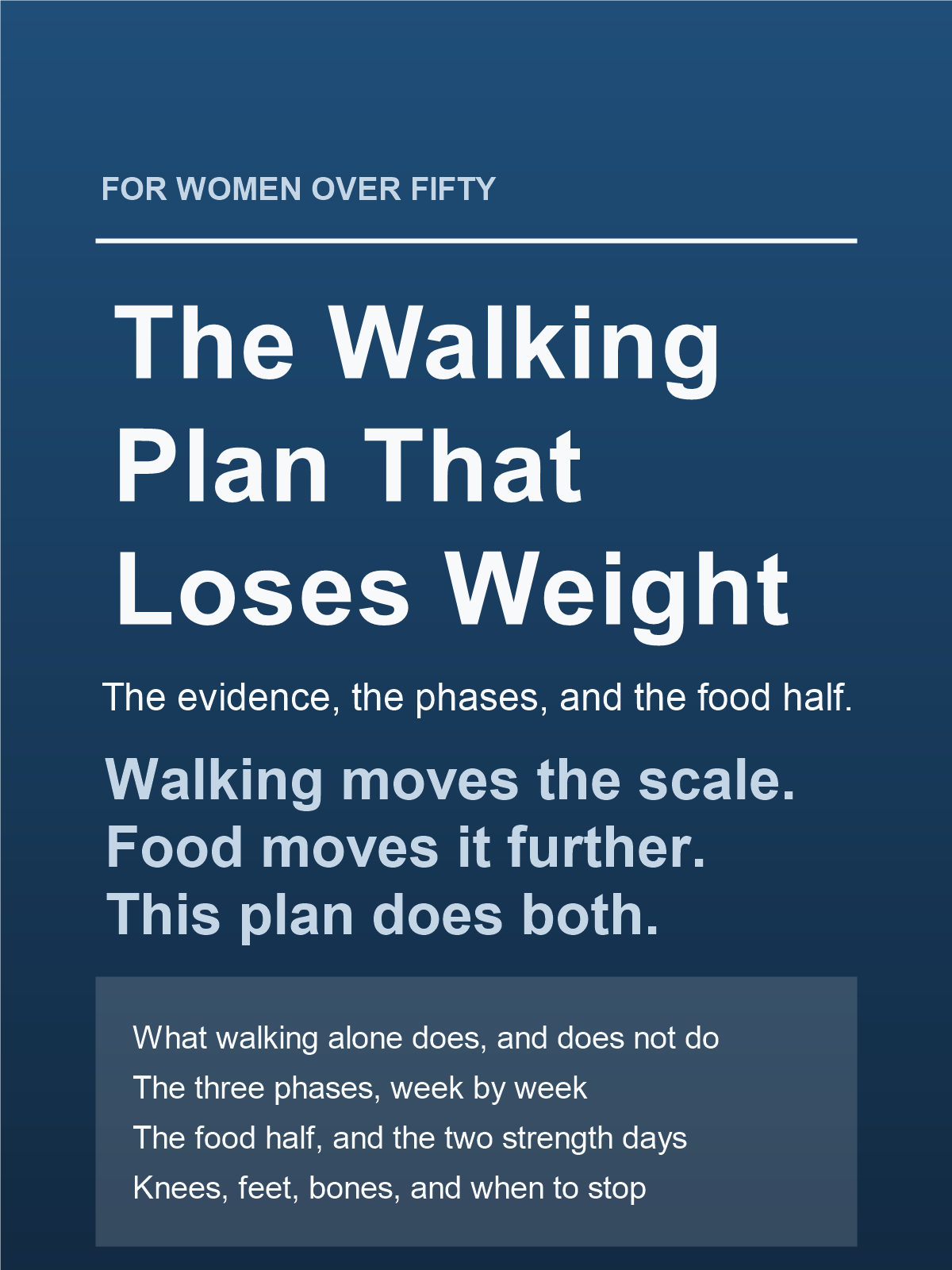
Walking on its own is not a weight-loss method, and the best current evidence says so precisely: 2.17 kilos. That is the pooled difference in body weight between 1,571 postmenopausal women doing aerobic training and a matched group doing nothing, across sixteen randomised controlled trials. The Chief Medical Officers of the United Kingdom put it more bluntly in their guidelines refreshed on 10 July 2026: diet is the important factor in weight management, and physical activity plays a supporting role. This guide opens with all of that, because a book that hides the weakness of its own subject is selling you something. Then it makes the case that genuinely holds, and it is a strong one. Brisk walking is the single exercise with the best evidence for maintaining bone density in adults over forty, at two to three hours a week. What is less commonly said is that losing weight itself reduces bone density, so a woman over fifty running a calorie deficit without walking in it is trading one risk for another. Ten chapters, three four-week phases week by week, the food half NICE says you cannot skip, and twenty-four strength sessions to protect the muscle walking will not build. A printable programme card, plain British English, no equipment and nothing to buy.
- Price
- £4.99
- Format
- Instant digital download
- Published
Opens the secure checkout in a new tab. Instant access after payment.
What's inside
- The unflattering number first. 16 randomised trials, 1,571 postmenopausal women: aerobic training against no exercise gave body weight -2.17 kg, fat mass -1.83 kg, waist -2.02 cm. Lean mass came back +0.72 kg and did not reach significance.
- There was no dose-response. The reviewers fitted curves to find the best dose and found no clear relationship between aerobic volume and the pooled effects. Baseline age was inversely linked to weight change. More is not more.
- What NICE says. Recommendation 1.15.2: increase activity even if you do not lose weight. 1.15.3: preventing obesity may need 45 to 60 minutes a day, avoiding regain 60 to 90. Those are maintenance figures, not starting ones.
- The case that holds is bone. A 2026 BMJ network meta-analysis of 124 trials and 18,429 adults over 40 found brisk walking or jogging the only single modality to improve total hip bone density. The dose: two to three hours a week.
- The part most plans leave out. Weight loss itself reduces bone density, and a 2026 review found the loss is greater in older and leaner adults. A deficit without walking in it trades one risk for another.
- Three phases of four weeks. Phase One rebuilds the base with three ten-minute walks a day. Phase Two builds to 150 minutes, adds hills from week six, intervals from week seven. Phase Three makes it automatic.
- Split your walks. In a trial in Obesity, 65 women in a 24-week programme lost 8.08 kg on two 25-minute sessions a day against 6.39 kg on one 50-minute session. They were 18 to 40, so read it with that in mind.
- The compensation chapter. In a four-month trial, exercisers ate back what they spent: 1.3 kg of compensation against 0.1 kg in controls. So there is a Change Audit - what did you eat the day you started, versus week four?
- Direction beats intensity. A 2026 cohort of 2,778 app users aged 40 to 74: people whose step counts were steadily rising were 2.45 times as likely to lose 3% of body weight than people flat at similar averages.
- The fortnight that ends programmes. A 2026 app trial found messages did not raise step counts at all but cut the risk of failing two weeks running by a third. Hence the Minimum Viable Day: ten minutes, your route, written down.
- Two strength days, because walking builds no muscle. Sit to stand, wall push-up, table row, hip hinge, calf raise. Twenty minutes twice a week, twenty-four sessions. A chair, a wall, a table and a backpack run it.
- Knees, feet, bones, and when to stop. Why downhill loads the joint behind your kneecap far more than uphill. Why losing weight costs bone. The three buckets that tell you when to walk through an ache and when to stop.
How you get it
- Pay securely through Payhip, the store that processes every order.
- The download link is emailed to you the moment payment clears.
- A PDF, readable on any phone, tablet or computer.