- foam rolling
- self-myofascial release
- muscle soreness
- sports recovery
- post-exercise recovery
- mobility
- flexibility
- range of motion
- strength training
- massage
- physiotherapy
- desk posture
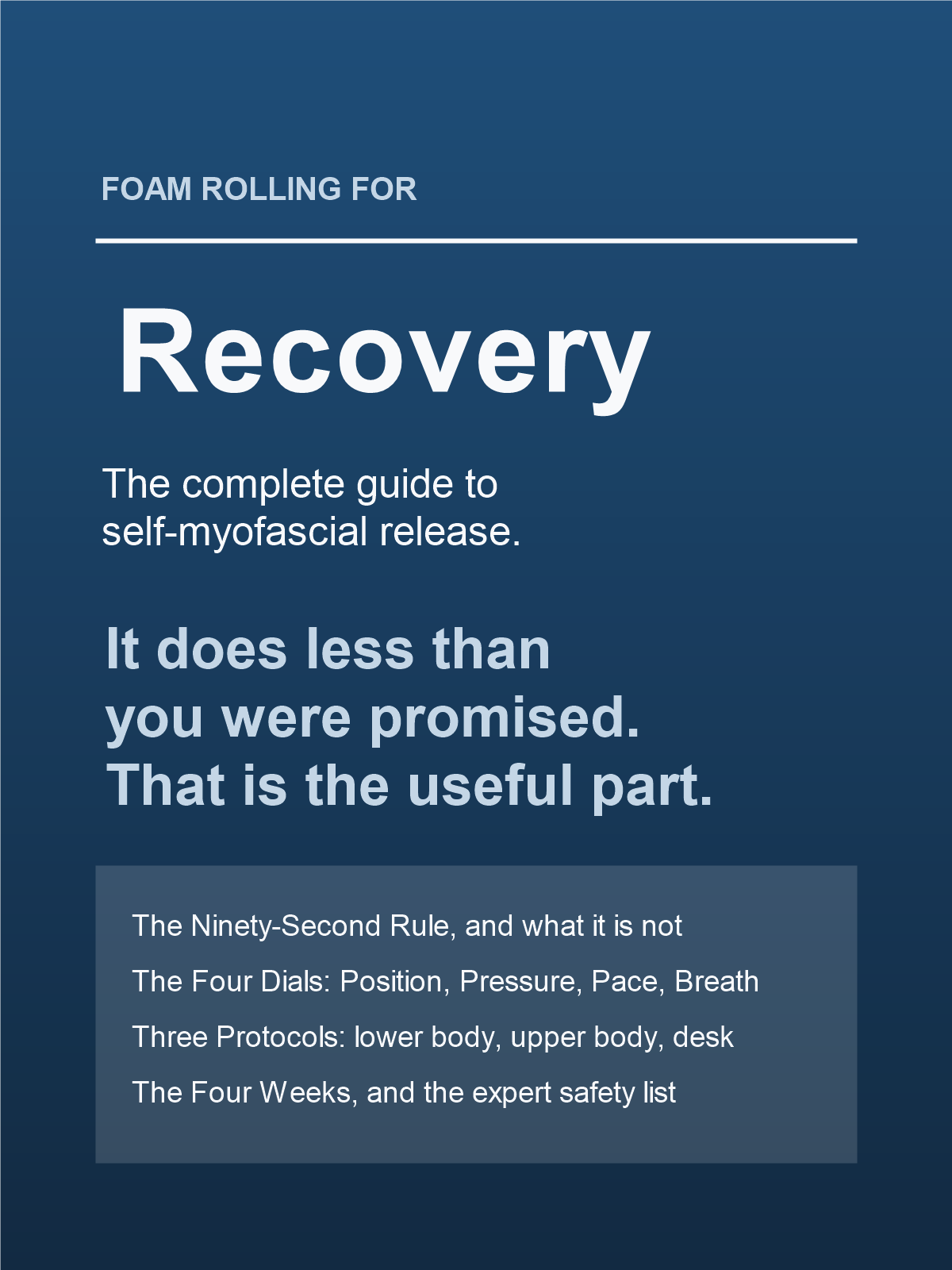
Foam Rolling for Recovery: The Complete Guide to Self-Myofascial Release
The evidence says foam rolling is a recovery tool, not a performance tool - and in the better trials, more rolling produced worse output. Women doing knee extensions after rolling completed significantly fewer repetitions than the control group, and the longer they rolled, the worse the result. Another trial found rolling reduced vertical jump height, and that five minutes of it reduced it more than one minute did. The claim that it breaks up adhesions does not survive contact with the data either: rolling one calf measurably reduced pain in the opposite calf, which was never touched. So what does it actually do? It briefly raises your pain tolerance, which buys a window in which a muscle tolerates more movement than it did a minute earlier. That window is worth having. It is not a treatment. This guide gives you the dose - ninety seconds per muscle is the evidence-based minimum and under forty-five seconds is wasted time - the technique, three follow-along protocols, a four-week progression for the only durable gain there is, and a safety list taken from a formal consensus of 37 experts rather than folklore. Ten chapters, ten named frameworks, and a printable Fifteen-Minute Card. Every figure checked against the peer-reviewed reviews, the Health and Safety Executive and the Office for National Statistics on the day of publication. No app, no class, no equipment to buy.
- Price
- £4.99
- Format
- Instant digital download
- Published
Opens the secure checkout in a new tab. Instant access after payment.
What's inside
- The honest opening: foam rolling is a recovery tool, not a performance tool. Women doing knee extensions after rolling completed significantly fewer reps than control, and the longer they rolled, the worse it got.
- The adhesion claim does not survive contact with the data. Rolling one calf measurably reduced pain in the opposite calf, which was never touched - which is not what breaking up scar tissue looks like.
- The Ninety-Second Rule: a review of 22 studies and 644 participants found 90 seconds per muscle group is the minimum dose that reliably works, under 45 seconds is probably wasted time, and there is no upper limit.
- The four verdicts. Soreness: strongly supported. Range of motion: large and immediate (effect size 0.76) but transient. Performance: not supported, and mildly contraindicated. Chronic pain: only ever shown as an addition to rehab.
- Chronic pain reality check: of the randomised trials in people with persistent musculoskeletal pain, only two found any benefit, and in both the roller was added to an exercise programme rather than used instead of one.
- Musculoskeletal problems are the third most common reason anyone gives for being off work in the UK - 14.6% of all sickness absence in 2025. The HSE counts 511,000 workers and 7.1 million days lost, an average of 14 per case.
- The Four Dials - Position, Pressure, Pace, Breath. Why lying on the floor is the worst first position, and why two seconds in and two seconds out is the only pressure gauge you actually need.
- Three Protocols, laid out muscle by muscle: lower body at 12 minutes, upper body at 11 minutes, and the desk-and-travel routine at 8 minutes for the days you have not trained.
- The Four-Week Progression, the only part that produces a lasting change. More than four weeks of regular work is needed before range-of-motion gains appear, and they show up in the muscle you actually roll.
- Safety from a formal consensus, not folklore. 37 experts: never roll over a bone fracture (84%) or an open wound (73%). Ask first for local inflammation (97%), DVT (97%), osteomyelitis (94%), myositis ossificans (92%).
- When rolling is the wrong tool: pain past six weeks is a diagnosis question, nerve symptoms are not a muscle problem, injury is not recovery - and the signs that mean 999 or A&E rather than a roller.
- A one-page Fifteen-Minute Card for the fridge, a 24-term glossary and ten verified sources. Written for people who have a roller, ten minutes and no gym. No app, no class, nothing to buy.
How you get it
- Pay securely through Payhip, the store that processes every order.
- The download link is emailed to you the moment payment clears.
- A PDF, readable on any phone, tablet or computer.